Hoccleve at Home: Alice Fulmer-Zelinka, Nov. 3

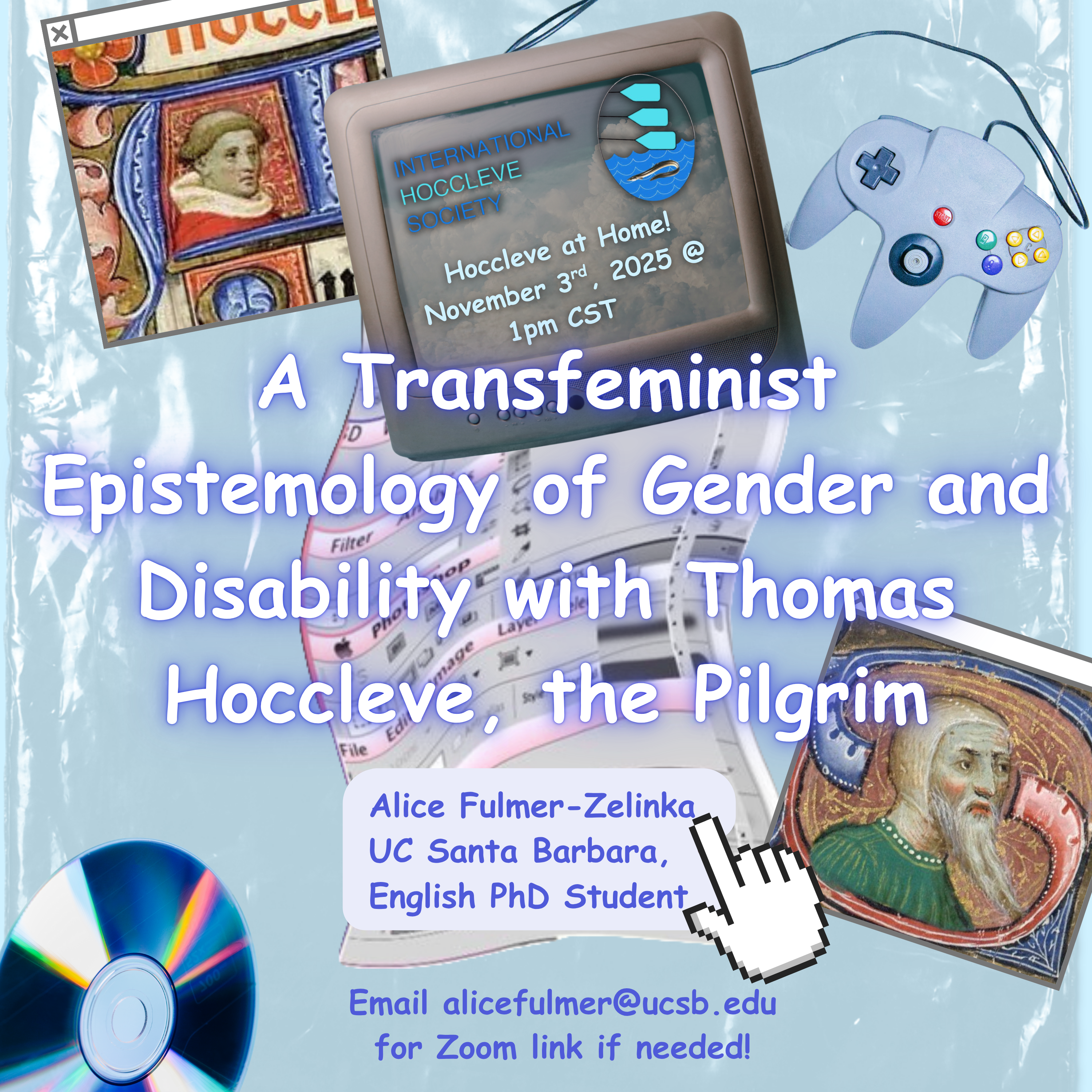
Hoccleve at Home, Nov. 3, 1pm CST
A Transfeminist Epistemology of Gender and Disability with Thomas Hoccleve, Pilgrim
Alice Fulmer-Zelinka, UCSB
Email alicefulmer@ucsb.edu or hocclevesociety@gmail.com for link

Please join us on Monday, November 3, 2025 (1PM North America Central time) for the first “Hoccleve at Home” event of the 2025-26 academic year. Our speaker will be Alice Fulmer-Zelinka (UC-Santa Barbara), who will give a talk titled, “A Transfeminist Epistemology of Gender and Disability with Thomas Hoccleve, the Pilgrim.” Here is a summary of Alice’s talk:

In this online talk, I will be highlighting instances in Thomas Hoccleve’s poetry that intersect autographically with Geoffrey Chaucer’s confessional pilgrims — a subset of the Canterbury Tales pilgrims. Poems such as “Lepistre de Cupide”, “Dialogus” and “Item de Beata Virgine” both present feminine voices directly, which I believe form a transfeminist epistemology and exceptional subjectivities of disability and gender. I believe that the trans affect that Hoccleve achieves in his Series is not only analogous to Chaucer’s confessional pilgrims, but that the subjectivity of the confessional pilgrims are direct antecedents to his trans confessionals in his Series which are placed in Thomas’ (Hoccleve’s fictive persona) autography.

Please email hocclevesociety@gmail.com for the video link.

Leave a comment

Filed under Hoccleve at Home

Hoccleve at Home: Charlotte Ross, Nov. 18

We are delighted to invite you to the next Hoccleve at Home event, featuring Charlotte Ross of Oxford University:

Charlotte Ross (Oxford University) 

‘Unto yow compyle I this sentence’: the Paratexts of The Regiment of Princes

Monday, November 18 at 1:30pm Central (2:30pm Eastern, 7:30pm UK & Ireland, 4:30am KST/JST)

If you’re not on our mailing list, contact hocclevesociety@gmail.com for the Zoom link.

Leave a comment

Filed under Uncategorized

Upcoming Hoccleve at Home events: Prof. Jonathan Hsy, Oct. 25; Charlotte Ross, Nov. 18

Mark your calendars for two upcoming Hoccleve at Home events:

Jonathan Hsy (George Washington University) 

“Hoccleve’s Ethiopians: Black Faces, Disability, Metaphor”

Friday, October 25 at 1pm Central (2pm Eastern, 7pm UK & Ireland)

This paper explores Hoccleve’s preoccupation with the human face and its implications for theorizing race and disability. The first section traces Hoccleve’s considerations of the human face—as a somatic feature, and as a metaphor—within a medieval English literary context, putting his historical reflections on embodied difference into conversation with critical disability studies. The second section turns to race—specifically, medieval constructions of blackness—to unmask the unmarked status of whiteness in Hoccleve’s work. The final section integrates race and disability, posing new questions for Hoccleve and Middle English studies. This discussion incorporates concepts of disability as “narrative prosthesis” in literary criticism, as well as studies of metaphor as a historical race-making process, and it ends by suggesting future intersectional and global approaches to Hoccleve’s poetics.

If you’re not on our mailing list, contact hocclevesociety@gmail.com for the Zoom link.

And please save the date for our next event! We are delighted to host Charlotte Ross (Oxford) for a talk on Monday, November 18. Details forthcoming.

Leave a comment

Filed under Uncategorized

Expanding Perspectives on Hoccleve and Gender: ICMS Kalamazoo 2025

In his notoriously laddish introduction to The Minor Poems, Frederick Furnivall wishes that Thomas Hoccleve had been “a manlier fellow.” Furnivall’s judgment reflects straitened Victorian gender norms that have little to do with medieval reality. But Hoccleve’s relationship to masculinity, femininity, and the gender politics of his own era remains an open question in criticism.

This panel, sponsored by the International Hoccleve Society, invites reconsiderations of Hoccleve and gender. We welcome papers that revisit topics long debated by Hoccleveans: his relationship to Christine de Pizan as author, for instance, and the changes his Letter of Cupid makes to Christine’s L’Epistre au Dieu d’Amours; his women patrons and readers; his flirtations with misogynist discourse; his Marian devotion; his account of his marriage as impediment to his career; or his role in inventing a patrilineal model of English literary succession. But we also invite papers that find new vantage points on Hoccleve and gender, including studies of the intersections of gender and class; the gendering of mental illness; gender performance in and via Hoccleve’s writing; the homosociality of the Privy Seal; and currents of identification, embodiment, and/or desire that have thus far been overlooked. Papers that draw on trans studies, intersectional feminist thought, and new documentary insights about medieval gender are particularly welcome.

Please send abstracts of no more than 300 words, along with a completed Participant Information Form, to Arwen Taylor (ataylor52 at atu.edu) and Spencer Strub (spencer.strub at princeton.edu), by September 15, 2024. 

Leave a comment

Filed under CFP, Conference panels

Upcoming Hoccleve at Home event: Prof. Daniel Davies, April 15

Mark your calendars for the second Hoccleve at Home event of 2024:

Daniel Davies (University of Houston)

“Thomas Hoccleve and the English War State”

Monday, April 15

1pm Central (2pm Eastern, 7pm GMT) on Zoom

The impact of Thomas Hoccleve’s work in the Privy Seal has long been recognized as shaping his poetry. But what of his labor supporting the English war state? As one of the many bureaucrats who facilitated war through labor that paid soldiers, secured ordinances, issued safe conducts, and instructed military commanders, among other things, war for Hoccleve was an everyday part of his work. I will locate Hoccleve’s career in the Privy Seal within the landscape of England’s late-medieval wars in France, Wales, and Scotland, before considering pathways between Hoccleve’s wartime labor and his poetry. 

If you’re not on our mailing list, contact hocclevesociety@gmail.com for the link.

Leave a comment

Filed under Hoccleve at Home

In memoriam: Jenni Nuttall

We are very sorry to report that our dear friend and colleague Dr. Jenni Nuttall has passed away. Jenni has been ill for some months, and she passed away at the end of last week.

Our thoughts go out to her husband Jon and daughter Molly. Her death is a source of great sadness and shock to all of us.

Jenni was a much respected scholar, teacher and member of the English Faculty and Exeter College communities at Oxford. Their reflections attest to her importance as a researcher, teacher, and public-facing scholar. Jenni was a longtime and tireless supporter of the work of the Hoccleve Society, most recently in co-organizing the inaugural society conference in 2018 and co-editing the volume that proceeded from the conference (both with David Watt). Several of the modern English translations available on the Hoccleve Society website are her work, which she made freely available for Hoccleve scholars, and she was among the first to speak for our “Hoccleve at Home” online seminars and helped us successfully launch the series.

We are deeply saddened by the news and will miss her a great deal.

Leave a comment

Filed under Uncategorized

Upcoming Hoccleve at Home event: Prof. Joyce Coleman, Feb. 12

Mark your calendars for the first Hoccleve at Home event of 2024:

Joyce Coleman (Oklahoma University)

“Hoccleve vs. Mowbray: Whose Book Is It?”

Monday, Feb 12, 2024

1pm Central (2pm Eastern, 7pm GMT) on Zoom

If you’re not on our mailing list, contact hocclevesociety@gmail.com for the link

Writing in 1994, Derek Pearsall suggested that, c. 1411-13, the future Henry V had commissioned Thomas Hoccleve to write The Regiment of Princes, and then to oversee the creation of copies to distribute among important courtiers, in “a concerted attempt … to cement relationships with possibly doubtful friends.”

Ten years earlier, however, Kate Harris had proposed that the arms in the initials under the famous presentation image and on ff. 1 and 71 of London, BL Arundel 38 were all linked to John Mowbray, the future duke of Norfolk—not to the prince and to Thomas FitzAlan, earl of Arundel, as had long been accepted. This discovery convinced some scholars that Mowbray had commissioned at least the Arundel manuscript, and that the kneeling presenter was Mowbray, not the author, Hoccleve. Alternatively, other scholars (and various online sites) claim that the image shows Henry presenting the book to the kneeling Mowbray. These theories have tended to overshadow Pearsall’s argument.  

Prof. Coleman’s talk will re-examine this controversy, supporting Pearsall’s suggestions, and the kneeler’s authorial identity, via analysis of the layout of the presentation image and of the controversial pink gown.

Leave a comment

Filed under Hoccleve at Home

Publication alert: Thomas Hoccleve’s Collected Shorter Poems, ed. Sebastian Langdell

All Hoccleveans and the Hoccleve-curious are strongly encouraged to check out IHS Assistant Director Sebastian Langdell’s latest book, the first modern critical edition of the full corpus of Hoccleve’s minor poems. It’s available now from Liverpool University Press:

Thomas Hoccleve produced the first author-curated ‘collected poems’ in the English language, preserved in two complementary manuscripts: Huntington Library, MSS HM 111 and HM 744 (copied 1422-26). This is the first full modern edition of these poems. The twenty-eight pieces span Hoccleve’s entire career: they range from stirring devotional verse, to playful autobiography, deft translations of Latin and French texts, and timely political verse. The collection comprises the entirety of Hoccleve’s poetic corpus, save his two longer works, the Regiment of Princes and the Series. It includes some of Hoccleve’s most celebrated and widely studied poems, including ‘The Epistle of Cupid’, ‘La Male Regle’, ‘To Sir John Oldcastle’, ‘Complaint Paramount’, ‘Learn to Die’, and ‘The Court of Good Company’. This edition engages for the first time with newly identified sources of poems; it also offers comprehensive textual variants for the poems, a full up-to-date chronology, and explanatory notes that engage with the wealth of recent scholarship on Hoccleve – including newly discovered details about Hoccleve’s life and the dates of his poems, his relationship with heresy and orthodox reform movements, and his positioning within London scribal circles and coterie readerships.

This book was funded by fellowships from the National Endowment for the Humanities and the Huntington Library.

Leave a comment

Filed under Editions, Publications

“1415: A Year in the Life of Thomas Hoccleve”: Hoccleve Society Workshop, ICMS Kalamazoo 2023

Our ICMS Kalamazoo workshop this year – “1415: A Year in the Life of Thomas Hoccleve” – is Session 306, a virtual session scheduled for 7pm (Eastern) on Friday, May 12. For this 90-minute workshop, we have assembled a virtual panel of participants to facilitate and lead discussions focused on the importance of 1415 — a pivotal date for several short poems and the approximate year of Hoccleve’s mental breakdown — on teaching and studying Hoccleve and his works.

Holly Crocker (University of South Carolina), Sebastian Langdell (Baylor University), and Misty Schieberle (University of Kansas) will lead the workshop, and Ruen-chuan Ma will serve as moderator. The titles of each participant’s presentation are as follows:

  • Holly Crocker – “1415: Hoccleve’s Illness, and Women’s Friendship”
  • Sebastian Langdell – “Moveable Feats”
  • Misty Schieberle – “1415: Hoccleve and London Communities”

If you are attending ICMS, please join us for this workshop, and similar to our ICMS workshop last year, the workshop leaders will each offer presentations (5-7 minutes in length) that invite conversations and discussion with each other and with attendees. We look forward to seeing you online!

Leave a comment

Filed under Conference panels

A new Hoccleve translation!

Someone knocked very hard at my chamber door
And shouted loudly, ‘Hey, Hoccleve! Are you here?
Open your door! I think it’s been a really long time
Since I saw you last. Listen, my friend, for God’s sake,
Come out, for I haven’t seen you this last three months
As far as I know,’ and so I came out to see him…

Dr. Jenni Nuttall continues her translation of Hoccleve’s Series into modern English with a verse translation of its second constituent part, the “Dialogue,” now freely available here. You can view other open-access texts and translations on the Texts page of this website.

If you use these resources in your teaching or research, we’d love to hear about it! You can contact the IHS at hocclevesociety@gmail.com or directly reach out to our organizers.

Leave a comment

Filed under Uncategorized